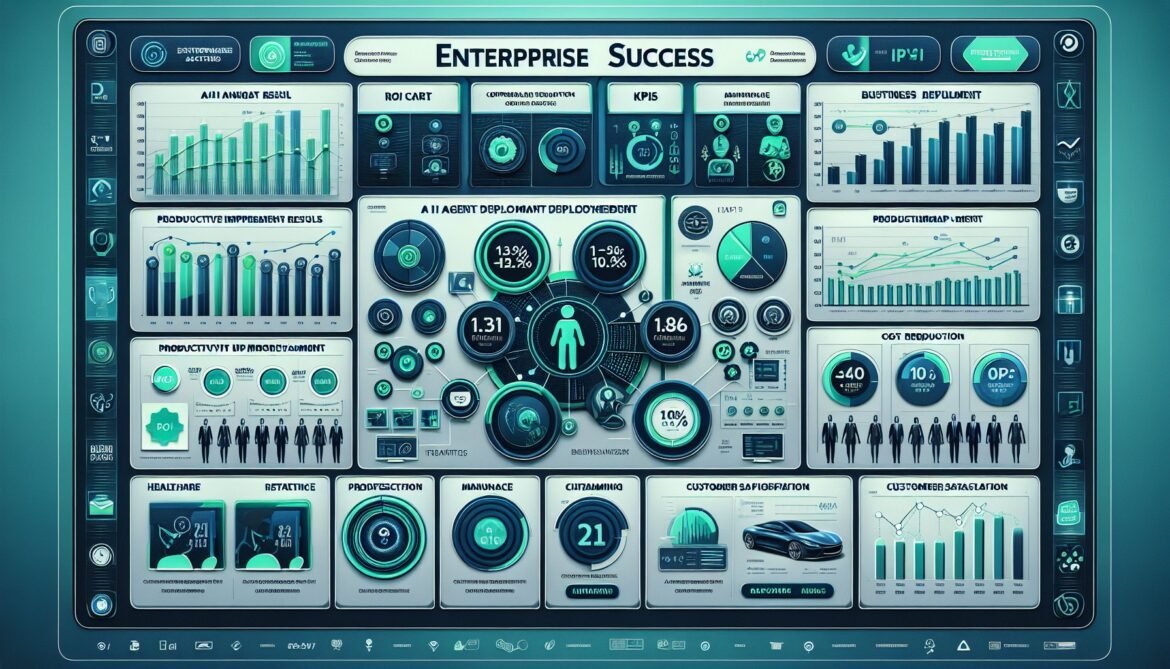
The enterprise agentic AI landscape shifted dramatically between 2024 and 2025 as systems moved from experimental pilots to production deployments delivering measurable business value. Gartner predicts 40% of enterprise applications will integrate task-specific AI agents by end of 2026, up from less than 5% in 2025. Organizations deploying agents report substantial returns including 40-70% request deflection in customer support, 60% cost reductions in operational expenses, 30-50% improvements in task completion time, and 10+ point increases in customer satisfaction scores. These results demonstrate that agentic AI has crossed the chasm from promising technology to production capability delivering ROI that justifies enterprise investment.
This article examines real-world implementations across industries demonstrating how organizations achieve production success with agentic systems. We explore quantified outcomes from customer service deployments, IT operations automation, healthcare revenue cycle management, financial services applications, and supply chain optimization. These case studies provide patterns that organizations replicate when deploying their own agent systems.
Customer Service: Klarna and Intercom
Klarna deployed an AI customer service assistant in early 2024 that demonstrated the transformative potential of agents in high-volume support operations. The agent handled two-thirds of incoming support chats in its first month, managing 2.3 million conversations. Resolution time dropped from 11 minutes to under 2 minutes. The system equated to approximately 700 full-time employees of capacity. Klarna cited an estimated $40 million profit improvement in 2024 tied to AI efficiencies and highlighted a 40% reduction in cost per transaction since Q1 2023.
Intercom deployed Fin AI Agent powered by Anthropic Claude achieving 51% average automated resolution across customers with some implementations exceeding that substantially. Synthesia saved over 1,300 support hours in six months, resolving more than 6,000 conversations autonomously. During a 690% volume spike, 98.3% of users self-served without human escalation. These deployments demonstrate that agents handle not just simple queries but complex multi-turn interactions requiring context maintenance and reasoning.
IT Operations: DoorDash and Equinix
DoorDash deployed an AWS Bedrock-powered voice support agent achieving sub-3-second latency in production. The low-latency interaction proved critical for user acceptance with faster response times correlating directly to higher containment rates and satisfaction scores. The implementation demonstrated that voice agents require different architectural considerations than text-based systems, particularly around streaming responses and interrupt handling.
Equinix implemented an E-Bot powered by Moveworks integrated with Microsoft Teams achieving 68% deflection on employee requests and 43% autonomous resolution. The agent handles IT support tickets, access provisioning, policy questions, and system status inquiries without creating tickets or involving human agents. Other Moveworks customers report similar deflection rates demonstrating consistent performance across deployments when agents have proper system integration and knowledge base coverage.
Healthcare Revenue Cycle: Easterseals
Thoughtful AI deployed specialized autonomous agents across revenue cycle management processes for Easterseals addressing high accounts receivable days and frequent claim denials. The billing team spent excessive time on repetitive eligibility checks, coding, claims submission, and appeals. Six specialized agents named Eva, Paula, Cody, Cam, Dan, and Phil handle end-to-end workflows coordinating across EHR systems and payer portals.
The agents learn from prior denials and adapt workflows over time. Staff focus shifted from manual transactions to process improvement activities. The implementation demonstrates multi-agent orchestration in production where specialized agents handle different workflow stages while maintaining consistency across the revenue cycle. Healthcare organizations face particular compliance requirements making this deployment notable for demonstrating agent systems operating within strict regulatory boundaries.
Financial Services: Paycor Sales Operations
Paycor adopted Gong’s AI platform to improve pipeline management, forecasting accuracy, and coaching capabilities. The company reports a 141% surge in deal wins after deployment. The agent analyzes sales calls, identifies coaching opportunities, provides pipeline insights, and improves forecast accuracy. Related implementations show improved win rates, revenue per representative, and forecast accuracy within months of rollout.
The financial services applications demonstrate agents operating in advisory roles rather than pure automation. The agent augments human decision-making by surfacing insights from conversation analysis, identifying patterns across successful deals, and providing coaching feedback that improves team performance. This collaborative pattern proves effective when decisions require human judgment but benefit from AI-powered analysis.
Common Success Patterns
Successful deployments share identifiable patterns regardless of industry or use case. Organizations start with high-volume, well-defined processes where success metrics are measurable. Customer support, IT operations, and billing workflows fit this profile with clear containment and resolution metrics. Implementations establish guardrails and human oversight for edge cases. Agents handle routine scenarios autonomously while escalating complex situations to human specialists.
Integration depth determines agent effectiveness. Deployments with proper API access, authentication integration, and data synchronization achieve substantially higher resolution rates than those with limited system access. Knowledge base quality matters tremendously with comprehensive, current documentation enabling agents to handle broader query ranges. Organizations invest in documentation as part of agent deployment recognizing that knowledge gaps limit agent capabilities regardless of model sophistication.
Measurement rigor separates successful implementations from those that struggle to demonstrate value. Organizations track containment rates, resolution time, customer satisfaction, cost per interaction, and escalation patterns. These metrics guide continuous improvement efforts where organizations identify failure patterns, expand knowledge bases, and refine agent behaviors based on production data.
Implementation Challenges and Solutions
Production deployments face predictable challenges that organizations address through architectural and operational patterns. Change management proves critical as agents alter how work gets done. Employees transition from task execution to agent supervision and exception handling. Organizations provide training on agent collaboration, oversight responsibilities, and escalation procedures.
System integration complexity often exceeds initial estimates. Agents require access to multiple systems with proper authentication, authorization, and audit logging. Organizations establish integration teams combining AI expertise with system administration knowledge to ensure agents operate within existing security and compliance boundaries. Data quality issues surface during deployment as agents expose gaps in data consistency, completeness, and accuracy that humans work around intuitively.
Cost management requires attention as token consumption, API calls, and infrastructure expenses accumulate with production usage. Organizations implement caching strategies, response optimization, and model routing to balance performance against cost. Monitoring systems track usage patterns enabling cost optimization without degrading user experience.
Conclusion
Real-world deployments demonstrate that agentic AI delivers measurable value when implemented thoughtfully with proper integration, oversight, and continuous improvement. The case studies examined show consistent patterns of 40-70% automation in well-defined processes, substantial cost reductions through operational efficiency, and improved customer satisfaction from faster, more consistent service. Organizations approaching agent deployment with realistic expectations, proper technical foundation, and commitment to ongoing optimization achieve production success that justifies continued investment in autonomous AI capabilities.
The agentic AI landscape continues evolving rapidly as models improve, integration standards mature, and organizations develop operational expertise. Early adopters gain competitive advantages through reduced operational costs, improved service quality, and organizational learning that compounds over time. The transformation from experimental technology to production capability represents one of the most significant shifts in enterprise software, enabling automation of cognitive work that previously required human intelligence.
References
- 9 Best AI Agents Case Studies 2025: Real Enterprise Results
- Gartner Predicts 40% of Enterprise Apps Will Feature AI Agents by 2026
- The Hottest Agentic AI Examples and Use Cases in 2025
- Top 25 Agentic AI Use Cases Delivering Results in 2025
- Top 10 AI Agent Useful Case Study Examples in 2025
- Agentic AI Use Cases That Prove the Power – Moveworks
- 10 Agentic AI Examples and Use Cases – Boomi
- Top 7 Agentic AI Use Cases in 2025 With Real-World Examples