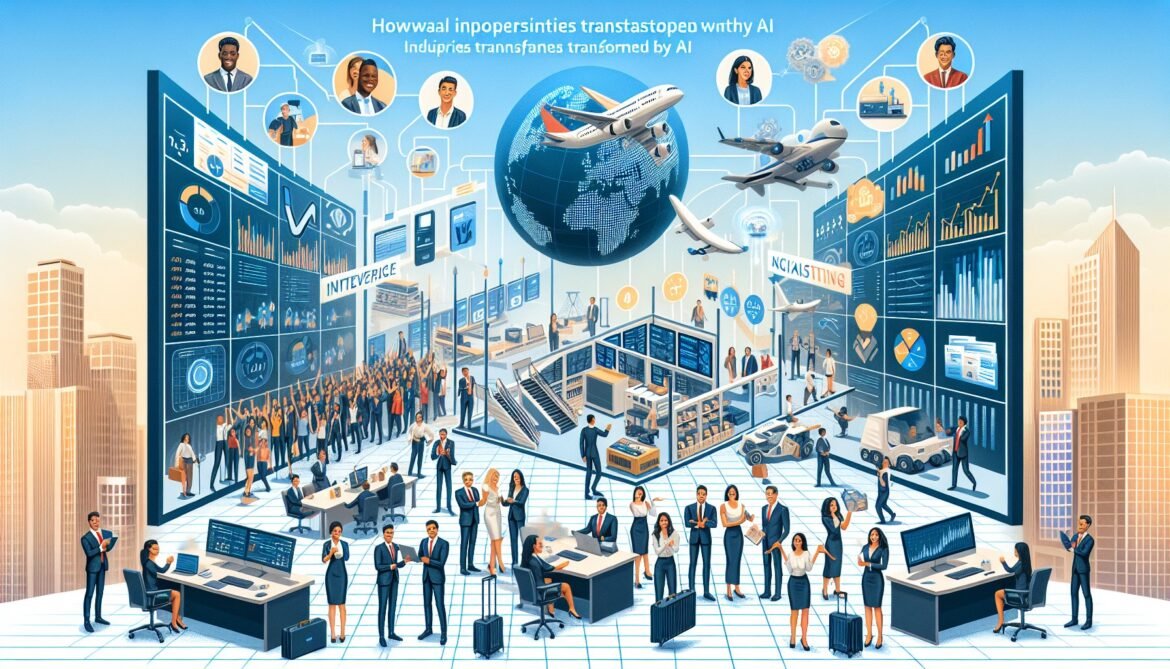
The transformation from theoretical capabilities to production systems delivering measurable business value requires navigating technical challenges, organizational change, and operational complexity. This final article in our series examines detailed case studies from organizations successfully deploying agentic AI systems using Azure AI Foundry. These implementations span multiple industries including aviation, tax preparation, automotive manufacturing, and technology services, demonstrating diverse applications and quantified outcomes that validate the business case for agentic AI adoption.
Each case study provides comprehensive implementation details including business challenges driving adoption, architectural decisions and technical approaches, deployment strategies and timeline, quantified business outcomes, lessons learned from production operations, and future roadmap directions. These real-world examples offer practical guidance for organizations planning their own agentic AI implementations, revealing both opportunities and challenges encountered during enterprise deployments.
Air India: Customer Service Transformation at Scale
Air India, India’s flagship carrier with millions of annual passengers, undertook a five-year digital transformation addressing decades of technical debt and operational inefficiencies. The airline faced challenges including inefficient handling of massive query volumes, high operational costs for customer support, outdated technology infrastructure, and gaps in modern customer interaction capabilities. Customer expectations evolved rapidly with passengers demanding instant responses, 24/7 availability, and seamless multi-channel experiences.
The airline selected Azure AI Foundry Agent Service as the foundation for intelligent customer support automation. This decision leveraged Azure’s global security capabilities, seamless worldwide accessibility, and comprehensive AI platform meeting enterprise requirements for mission-critical customer-facing systems.
The implementation deployed natural language processing powered virtual assistants handling diverse customer queries through conversational interfaces. The architecture integrated Azure OpenAI services providing language understanding and generation capabilities. Agent systems connect to multiple backend services including reservation systems, flight status databases, baggage tracking platforms, and customer profile databases. Document scanning capabilities enable automated processing of customer documentation like tickets, identification, and travel documents. Integration with existing call center systems provides seamless escalation paths when agents require human intervention.
The deployment approach emphasized security and reliability appropriate for airline operations. Microsoft Sentinel provides Security Operations Center capabilities monitoring for cybersecurity incidents and threats. Azure monitoring tools track performance metrics, system availability, and resource utilization ensuring consistent service delivery. The platform executed approximately 85 production cutovers migrating from legacy systems without service disruption demonstrating robust change management practices.
Business outcomes demonstrate significant operational improvements and customer experience enhancements. The airline achieved 60 percent automation of customer queries reducing support costs while maintaining service quality. Over 60 percent of customer sessions now complete fully automated without human agent involvement. Response times improved dramatically with instant answers replacing extended wait times. The system operates 24/7 providing consistent support across time zones and peak demand periods. Customer satisfaction metrics showed measurable improvements as passengers received faster, more accurate responses.
The advanced analytics and AI platform serves all business lines providing data-driven insights informing operational decisions. The Gen AI based chatbot named AI.g delivers tremendous operational improvements across multiple areas including customer experience, internal operations, and service delivery. The entire API backend and notification system modernization resulted in performance enhancements supporting the airline’s growth objectives.
Lessons learned emphasize the importance of comprehensive security implementation for customer-facing systems. End-to-end protection across applications prevents data breaches and maintains customer trust. Gradual migration approaches minimizing disruption proved essential for maintaining operational continuity during transformation. Integration with existing systems rather than wholesale replacement reduced risk and preserved institutional knowledge embedded in legacy platforms.
H&R Block: Tax Document Processing Automation
H&R Block, the trusted tax preparation company serving millions of filers annually, faces extreme seasonal demand during tax season. The company processes vast quantities of documents under tight deadlines with 25 percent of annual business occurring within just days. Challenges included time-consuming manual document handling, accuracy requirements for financial data extraction, the need for real-time tax question answering, and scaling support during peak demand periods.
The company selected Azure AI Foundry and Azure OpenAI Service based on Microsoft’s leadership in AI and security plus longstanding partnership between organizations. This technology choice provided enterprise-grade security for sensitive financial data, advanced AI capabilities for complex tax scenarios, reliability meeting seasonal demand surges, and compliance with financial services regulations.
Implementation created an intelligent application automating key data extraction from tax documents. The system processes diverse document types including W-2 forms, 1099 statements, mortgage interest forms, charitable contribution receipts, and business expense documentation. Document Intelligence extracts structured information from unstructured forms identifying key-value pairs, tables, and relevant data fields. Validation logic verifies extracted data against tax rules ensuring accuracy and compliance.
The conversational interface answers tax questions in real-time helping filers understand complex tax scenarios. Integration with Azure OpenAI provides natural language understanding interpreting customer questions across diverse phrasings and terminology. Knowledge retrieval accesses comprehensive tax code information, filing requirements, deduction rules, and credit eligibility criteria. Personalized guidance considers individual filer circumstances providing relevant advice rather than generic information.
Security safeguards protect sensitive financial information throughout processing. Encryption at rest and in transit prevents unauthorized data access. Access controls limit system access to authorized personnel only. Audit logging tracks all data access and processing operations maintaining compliance documentation. Data retention policies ensure information deletion after required retention periods minimizing long-term exposure.
Business outcomes delivered significant operational improvements during the critical tax season. The solution reduced time and manual effort in document handling freeing staff for complex cases requiring human expertise. Accuracy increased dramatically as automated extraction eliminated human transcription errors. The overall tax preparation process accelerated enabling faster customer service. System scalability handled seasonal demand spikes without proportional staffing increases. Customer satisfaction improved as filers received faster, more accurate service during the stressful tax filing period.
Lessons learned highlight the importance of accuracy verification for financial applications. Multiple validation layers including rule-based checks and statistical anomaly detection catch errors before downstream processing. Human review workflows for edge cases and unusual situations maintain quality while maximizing automation benefits. Comprehensive testing under peak load conditions validated system capacity before production deployment during tax season.
Volvo Group: Invoice and Claims Processing Efficiency
Volvo Group processes thousands of invoices and claims documents across global operations. Manual document processing consumed significant time and resources while introducing errors through human handling. Challenges included processing thousands of documents across multiple formats and languages, resource-intensive manual data entry and verification, error rates from manual transcription, and difficulty scaling operations to handle volume variations.
The company selected Azure AI Document Intelligence for its advanced document processing capabilities. This choice provided pre-built models for invoices and common business documents, custom model training for organization-specific document formats, multi-language support for global operations, and integration with existing enterprise systems.
Implementation automated invoice and claims handling end-to-end. Document ingestion accepts submissions through email, web portals, and API integrations. OCR and extraction apply appropriate Document Intelligence models based on document classification. Extracted data flows to validation processes checking amounts, vendor information, and business rules. Approved documents integrate with accounts payable systems for payment processing. Exception handling routes problematic documents to human reviewers with context about why automation failed.
The architecture emphasizes reliability and auditability. All processing steps log to centralized systems providing complete audit trails. Document retention policies maintain originals and processing history meeting regulatory requirements. Error recovery mechanisms handle transient failures without losing documents or requiring resubmission.
Business outcomes demonstrate substantial operational improvements. The company saved over 10,000 manual work hours since launch representing approximately 850 hours monthly. This time savings freed staff for higher-value analytical work and exception handling. Processing speed increased dramatically with automated workflows completing in minutes versus hours or days for manual processing. Error rates decreased as automated extraction eliminated transcription mistakes. The solution scaled efficiently handling volume fluctuations without proportional staffing adjustments.
Lessons learned emphasize starting with high-volume, standardized documents for initial automation. Invoice processing provided clear ROI justifying expansion to other document types. Iterative improvement based on production feedback refined extraction accuracy over time. Change management preparing staff for new workflows proved essential for adoption. Integration testing with downstream systems caught issues before production deployment preventing business disruption.
NTT DATA: Enterprise-Wide Data Intelligence with Agentic AI
NTT DATA, a global technology services provider, sought to transform how the organization interacts with enterprise data. Traditional dashboard and reporting approaches created bottlenecks with business users depending on analysts for insights. Challenges included data silos across business units limiting accessibility, technical barriers preventing business users from self-service analytics, delayed decision-making while waiting for analysis, and inconsistent data interpretation across teams.
The company selected Microsoft Fabric integrated with Azure AI Foundry Agent Service. This combination provided unified data platform consolidating enterprise data, conversational data access through natural language, intelligent agents delivering role-specific insights, and seamless integration with existing tools and workflows.
Implementation created conversational agents querying enterprise data across multiple systems. Microsoft Fabric OneLake serves as the unified data lake consolidating information from disparate sources. Fabric data agents enable natural language queries allowing business users to ask questions without SQL knowledge. Azure AI Agent Service powers intelligent responses analyzing data, identifying patterns, and recommending actions. Role-based access ensures users only see data appropriate for their responsibilities maintaining security and compliance.
The architecture evolved from simple chatbots to sophisticated autonomous agents. Early implementations provided query capabilities answering factual questions about data. Advanced agents perform analysis, generate insights, and recommend actions based on findings. Integration with workflows enables agents to trigger business processes based on data conditions. Multi-agent coordination combines specialists handling different data domains or analytical techniques.
Specific applications demonstrate practical value. HR and back office operations agents conduct conversations with operational data understanding organizational patterns and trends. Sales coach agents prepare representatives for meetings, draft proposals, and uncover client-specific insights using enterprise-grounded data. Data product development accelerates with agents helping teams build analytical solutions quickly even for non-technical users.
Business outcomes show significant improvements across multiple dimensions. Time to market improved by at least 50 percent for new data products and analytical solutions. Decision-making speed increased as business users obtained insights immediately rather than waiting for analyst availability. Data product scalability improved with rapid deployment even for non-technical users. IT service desk automation reached up to 65 percent reducing support costs and response times. Certain order workflows achieved up to 100 percent automation eliminating manual processing entirely.
The company expects compound ROI as the framework expands across more use cases and business units. Demonstrable rapid value generation proves the efficacy of solutions NTT DATA takes to market with the company serving as client zero validating approaches before customer deployment.
Lessons learned emphasize the importance of unified data platforms before deploying intelligent agents. Data quality and accessibility directly impact agent effectiveness. Starting with well-defined use cases demonstrating clear value builds organizational confidence. Governance frameworks ensuring security and compliance enable broader deployment. Continuous learning from production usage improves agent capabilities over time.
EchoStar Hughes: Multi-Application Automation Portfolio
EchoStar Hughes division operates in the satellite communications industry serving diverse customer segments. Business processes included manual activities consuming significant time and resources. Opportunities existed across multiple operational areas including sales operations, customer retention programs, and field service management.
The organization deployed Azure AI Foundry creating a portfolio of 12 production applications. This comprehensive approach automated diverse business processes rather than focusing on a single use case. Application areas span automated sales call auditing analyzing recorded calls for quality assurance and training purposes, customer retention analysis identifying at-risk customers and recommending intervention strategies, field services process automation streamlining technician dispatch and work order management, and additional operational improvements across business functions.
Implementation followed a rapid development approach leveraging Azure AI Foundry capabilities. Pre-built models and services accelerated development timelines. Integration with existing systems provided access to necessary data and workflows. Iterative deployment released applications progressively rather than attempting simultaneous launch. Continuous improvement refined applications based on user feedback and operational metrics.
Business outcomes demonstrate substantial enterprise-wide impact. The solutions project savings of 35,000 work hours annually representing significant cost reduction. Productivity improvements exceed 25 percent across affected business processes. Quality enhancements in sales operations improve customer interactions and conversion rates. Field service efficiency gains reduce customer wait times and operational costs. Retention program effectiveness increases identifying and addressing customer concerns proactively.
Lessons learned highlight the value of portfolio approaches addressing multiple use cases simultaneously. Shared infrastructure and capabilities reduce per-application development costs. Cross-functional teams share learnings accelerating subsequent implementations. Executive sponsorship enabling investment in comprehensive automation proved essential for success. Metrics tracking demonstrating value justified continued investment and expansion.
BKW: Internal Knowledge Management and Media Relations
BKW, a Swiss energy company, needed efficient access to internal knowledge scattered across multiple systems and formats. Employees spent significant time searching for information impacting productivity. Media inquiries required researching background information before crafting responses creating delays in communications.
The company developed Edison, a platform using Microsoft Azure, Azure AI Foundry, and Azure OpenAI services. This solution provides secure, effective access to internal data through conversational interfaces. Implementation connected to enterprise knowledge sources including SharePoint, internal wikis, policy documents, and historical communications. Natural language understanding enables employees to ask questions using their own terminology. Context-aware responses consider the employee’s role and relevant information needs.
Deployment achieved rapid adoption and measurable improvements. Within two months of rollout, 8 percent of staff actively used Edison demonstrating strong organic adoption without mandatory usage policies. Media inquiries processed 50 percent faster as communications staff quickly accessed relevant background information. Over 40 use cases documented across the organization showing diverse applications beyond initial scope. These use cases span HR policies and procedures, technical documentation and standards, customer service information, and regulatory compliance requirements.
Lessons learned emphasize the value of rapid deployment cycles for user feedback. Two-month adoption metrics provided early validation guiding continued investment. Organic adoption through demonstrated value proved more effective than top-down mandates. Comprehensive use case documentation shared best practices accelerating value realization. Security implementation maintaining data access controls enabled deployment with sensitive information.
Cross-Industry Patterns and Insights
These case studies reveal common patterns contributing to successful agentic AI implementations. Organizations achieving measurable value share several characteristics worth highlighting for readers planning their own deployments.
Clear business objectives drive successful implementations. Each organization identified specific operational challenges with quantifiable impacts before selecting technology solutions. This clarity enabled focused development efforts and objective outcome measurement validating return on investment.
Integration with existing systems proved essential. Successful deployments connected agents to current operational systems rather than requiring wholesale replacement. This approach reduced implementation risk, preserved institutional knowledge, and enabled faster value delivery.
Security and compliance considerations influenced architecture decisions from the start. Organizations operating in regulated industries or handling sensitive data implemented comprehensive security controls meeting industry requirements. This proactive approach prevented costly retrofitting and enabled confident deployment.
Iterative approaches delivered better outcomes than big-bang deployments. Starting with focused use cases demonstrating clear value built organizational confidence. Early wins justified expansion to additional applications. Continuous improvement based on production feedback refined capabilities over time.
Change management and user adoption required dedicated attention. Technical implementation alone did not guarantee success. Training employees, communicating benefits, and supporting new workflows proved essential for realizing value. Organizations measuring adoption metrics identified opportunities for improvement.
Quantified outcomes validated business cases and justified continued investment. Metrics tracking time savings, cost reductions, quality improvements, and customer satisfaction provided objective evidence. These measurements informed strategic decisions about expanding automation across additional business processes.
Conclusion: The Path Forward
These real-world implementations demonstrate that agentic AI delivers measurable business value across diverse industries and use cases. Organizations achieving success combined clear business objectives, appropriate technology selection, comprehensive security implementation, iterative deployment approaches, and dedicated change management. Azure AI Foundry provides the enterprise-grade platform capabilities required for production deployments at scale.
This eight-part series covered the complete journey from strategic context through real-world implementations. Part 1 established the business case for agentic AI. Part 2 provided foundation setup guidance. Part 3 covered single agent implementation. Part 4 explored multi-agent orchestration. Part 5 detailed business automation patterns. Part 6 addressed production deployment. Part 7 examined security and compliance. This final part shared real-world success stories demonstrating proven value.
Organizations planning agentic AI implementations can learn from these examples. Start with clear business objectives and measurable success criteria. Select use cases demonstrating rapid value delivery. Implement comprehensive security and compliance controls. Deploy iteratively learning from production experience. Invest in change management ensuring user adoption. Measure outcomes objectively validating business impact. These practices position your organization for successful agentic AI transformation delivering competitive advantage through intelligent automation.