Enterprise IT security in 2026 has crossed a threshold that many defenders feared but few were fully prepared for. The M-Trends 2026 report from Mandiant, the World Economic Forum Global Cybersecurity Outlook 2026, and a cascade of vendor research released over the past 90 days collectively describe a threat landscape that has not merely evolved but fully industrialized. Attackers now hand off compromised access to specialist operators in 22 seconds. Ransomware groups routinely weaponize vulnerabilities before a patch exists. Geopolitical tensions are rewriting how enterprises design and fund their security posture. This post examines the most consequential findings from early 2026 and translates them into concrete priorities for IT leaders, CISOs, and practitioners.
The 22-Second Handoff: Attack Speed Reaches a Critical Threshold
The headline finding from Google Cloud’s M-Trends 2026 report is stark: the median time between initial access and handoff to a specialist threat actor has collapsed from over 8 hours in 2022 to just 22 seconds in 2025. This figure reflects a fundamental restructuring of the cybercrime economy into a modular, role-specialized pipeline where initial access brokers sell footholds in real time to ransomware operators, espionage groups, or data extortion specialists.
The report is grounded in over 500,000 hours of frontline incident investigations conducted by Mandiant globally in 2025. Key data points include the following:
- Voice phishing (vishing) accounted for 23% of all intrusions in 2025, overtaking email phishing (15%) as the dominant social engineering vector
- Prior compromise ranked as the top initial infection vector in ransomware operations at 30%, doubling from 15% in 2024
- The mean time to exploit a newly disclosed vulnerability dropped to negative 7 days, meaning exploitation routinely occurs before a patch is even released
- Software-based vulnerability exploitation (44.5%) overtook weak credentials (27.2%) as the primary attack vector in the second half of 2025
- Global median dwell time rose from 11 days to 14 days, indicating defenders have not kept pace with the speed of attacker movement
The operational implication is significant. Traditional detection timelines built around hours-long observation windows are no longer valid. Security operations centers must instrument for real-time behavioral anomaly detection rather than signature-based or periodic alerting.
Ransomware Reinvented: Zero-Days, RaaS Expansion, and Recovery Denial
Ransomware has shed its reputation as a blunt-force tool and has become a precision weapon. According to VulnCheck research, 56.4% of ransomware-related CVEs disclosed in 2025 were first identified through zero-day exploitation by financially motivated actors. This is a sharp rise from 33% in 2024. The shift away from stolen credentials toward zero-day exploitation means that even organizations with mature identity security programs face acute exposure during the window between vulnerability disclosure and patch deployment.
Ransomware-as-a-Service platforms have lowered the technical entry barrier to the point where actors with minimal skill can target hospitals, utilities, and government networks. The average cost of a ransomware-related incident now stands at $4.4 million according to industry tracking.
The most dangerous tactical evolution of 2025 and 2026 is the pivot toward Recovery Denial attacks. Rather than simply encrypting data and demanding a decryption key, modern extortion campaigns actively destroy backup repositories, corrupt recovery infrastructure, and target disaster recovery runbooks stored on accessible network shares. The objective is not merely to deny access to data but to eliminate the organization’s ability to restore operations independently, leaving payment as the only viable path. Organizations that believed their backup strategy constituted an adequate ransomware defense are discovering that assumption is no longer correct.
The Modern Attack Lifecycle
The following diagram illustrates the industrialized attack lifecycle that M-Trends 2026 documents, from initial compromise through double extortion:
flowchart LR\n A[Initial Compromise] -->|22-second handoff| B[Access Sold to Specialist Operator]\n B --> C[Privilege Escalation]\n C --> D[Lateral Movement Across Segments]\n D --> E[Backup and Recovery Systems Targeted]\n E --> F[Data Staged and Exfiltrated]\n F --> G[Recovery Denial Attack]\n G --> H[Double Extortion Demand avg 4.4M USD]
Zero Trust Architecture: From Framework to Survival Strategy
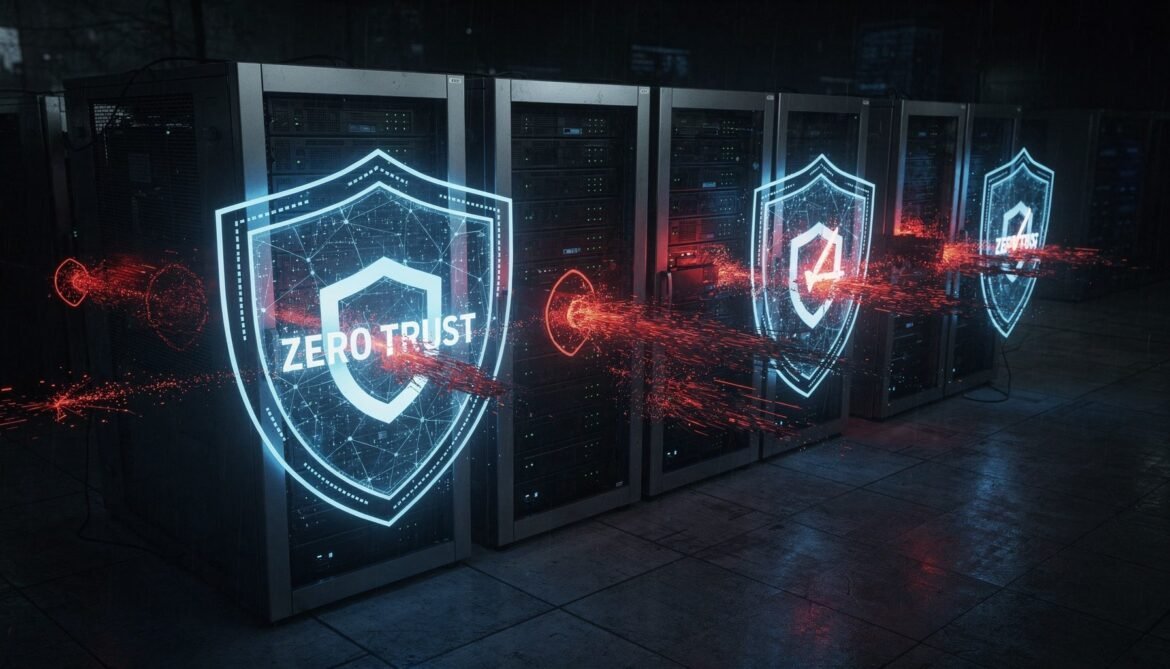
Zero Trust has graduated from a conceptual security framework to an operational mandate for any organization that stores sensitive data or operates critical systems. The model rejects implicit trust based on network location. Every request, whether originating inside or outside the corporate perimeter, must be authenticated, authorized, and continuously validated before access is granted.
The core principles of a mature Zero Trust implementation in 2026 are:
- Verify explicitly: Authenticate every user and device on every request using multi-factor authentication and real-time device posture signals. No session is implicitly trusted because a prior session was clean.
- Use least privilege access: Grant the minimum permissions required for each task and revoke them immediately after completion. Persistent broad access rights are a primary enabler of lateral movement.
- Assume breach: Design systems on the assumption that an adversary is already present inside the network perimeter. Apply micro-segmentation to contain blast radius and limit lateral movement between network zones.
- Continuous monitoring: Apply behavioral analytics to detect anomalous access patterns in real time. Static rule-based alerts are insufficient against attackers who move in seconds.
The following diagram illustrates the Zero Trust verification flow that enterprise networks must implement at each access request:
flowchart TD\n A[User or Device Initiates Access Request] --> B{Identity Verified via MFA?}\n B -->|No| R[Access Denied - Event Logged]\n B -->|Yes| C{Device Compliance Check}\n C -->|Fails Posture| R\n C -->|Passes| D{Least Privilege Policy Evaluation}\n D -->|No Matching Policy| R\n D -->|Policy Granted| E[Micro-Segmented Resource Access]\n E --> F{Continuous Behavioral Monitoring}\n F -->|Anomaly Detected| G[Session Terminated - SOC Alert Raised]\n F -->|Normal Behavior| H[Access Maintained Until Session End]Adoption of Zero Trust is accelerating. The convergence of identity security, data security, and network segmentation under a unified Zero Trust framework is now cited by practitioners surveyed in the WEF report as the single most critical security priority for 2026.
WEF Global Cybersecurity Outlook 2026: Geopolitics, AI, and the Inequity Gap
The World Economic Forum’s Global Cybersecurity Outlook 2026, released in January 2026, surveyed hundreds of executives and senior practitioners across public and private sectors. Its findings reveal a threat environment shaped not only by criminal actors but by geopolitical tensions, AI adoption asymmetry, and a widening capability gap between large and small organizations.
The most significant statistics from the report are as follows:
- 94% of respondents identified AI as the most significant driver of change in cybersecurity for the year ahead
- 87% identified AI-related vulnerabilities as the fastest-growing cyber risk over the course of 2025
- 64% of organizations now explicitly account for geopolitically motivated cyberattacks in their strategy, including disruption of critical infrastructure and state-sponsored espionage
- 91% of the largest global organizations have already changed their cybersecurity strategies in response to geopolitical volatility
- Less than 45% of private-sector CEOs are confident in their country’s ability to respond effectively to a major cyberattack on critical national infrastructure
- The percentage of organizations that assess the security of their own AI tools nearly doubled from 37% in 2025 to 64% in 2026
The WEF report also highlights a deepening structural divide the report labels “cyber inequity.” Organizations with larger balance sheets and mature AI programs report significantly higher defensive postures. Smaller enterprises, government bodies, and NGOs lag behind by years. This asymmetry creates systemic vulnerability within supply chains and critical infrastructure, where large well-defended enterprises depend on smaller, under-secured vendors and contractors who represent exploitable weak points.
Physical Infrastructure Joins the Digital Threat Surface
The attack surface for enterprise IT in 2026 is no longer exclusively digital. On March 1, 2026, a fire broke out inside an Amazon Web Services data center in the United Arab Emirates after unidentified objects struck the facility, marking what analysts describe as the first confirmed case of a major American cloud provider’s physical infrastructure being damaged by military action. The incident, documented in detail by ComplexDiscovery, forces a reassessment of cloud resilience assumptions that most enterprise continuity plans have never tested.
Multi-region redundancy, previously designed as a response to natural disasters and hardware failure, must now account for deliberate kinetic targeting of data center facilities. Business continuity plans that assume any single cloud availability zone is safe from physical interference may require fundamental revision for organizations operating in or serving geopolitically exposed regions.
Vendor Responses: HPE, Accenture, and Google Cloud at RSA 2026
The enterprise security vendor community responded to the 2026 threat landscape with significant announcements during RSA Conference 2026, held at the Moscone Center in San Francisco from March 23 to 26.
HPE announced expanded hybrid mesh firewall capabilities designed to apply enterprise-grade guardrails around AI workloads, alongside built-in security enhancements positioned as a core resilience requirement across its hybrid cloud portfolio. The announcement signals a market shift toward treating security not as a bolt-on capability but as a foundational infrastructure property.
Accenture extended its strategic partnership with Google Cloud, deploying the Google Security Operations platform in combination with Accenture’s Cybersecurity AI Migration Factory. The initiative targets SIEM modernization, accelerating migration from legacy platforms while improving detection against AI-driven attack vectors including autonomous malware and hyper-personalized social engineering. The program is specifically designed to reduce the migration effort that has historically caused organizations to defer SIEM upgrades for years.
What IT Leaders Must Prioritize in Q2 2026
The convergence of findings from M-Trends 2026, the WEF outlook, and vendor intelligence points to a clear set of actions for IT and security teams in the next 90 days:
- Reduce mean time to patch critical CVEs to under 48 hours. With exploitation occurring before patches are released in many documented cases, patch deployment velocity is now a primary defensive metric, not an operational convenience target.
- Deploy Zero Trust micro-segmentation across all network zones, including operational technology and cloud workloads. Lateral movement is the mechanism through which initial access becomes a catastrophic breach. Flat networks are no longer acceptable in any segment.
- Instrument vishing detection and implement mandatory callback verification protocols. Voice phishing is now the leading social engineering vector at 23% of intrusions. Most organizations remain structurally under-defended against it, having focused security awareness programs on email.
- Test backup and recovery infrastructure against active destruction scenarios, not just passive failure scenarios. Recovery Denial attacks specifically target backup systems. Tabletop exercises and recovery drills must include a scenario where backup infrastructure has been deliberately corrupted before the main incident is detected.
- Map geopolitical risk to data center location and vendor geographic concentration. Single-region cloud deployments and single-country vendor dependencies represent unquantified geopolitical exposure that most risk registers have not yet incorporated.
- Audit AI deployments for security posture before expanding AI usage. 87% of practitioners cite AI-related vulnerabilities as the fastest-growing risk category. Organizations that have deployed AI tooling without a parallel security assessment are carrying unknown exposure.
The 2026 enterprise IT threat landscape rewards speed, segmentation, and skepticism. Organizations that treat security as an infrastructure property rather than an overlay will be positioned to absorb the industrialized attacks that define this era. Those still operating on perimeter assumptions and annual patch cycles will continue to appear in the next edition of M-Trends.
References
- Google Cloud Mandiant – “M-Trends 2026: Data, Insights, and Strategies From the Frontlines” (https://cloud.google.com/blog/topics/threat-intelligence/m-trends-2026)
- SecurityWeek – “M-Trends 2026: Initial Access Handoff Shrinks From Hours to 22 Seconds” (https://www.securityweek.com/m-trends-2026-initial-access-handoff-shrinks-from-hours-to-22-seconds/)
- ComplexDiscovery – “Twenty-Two Seconds to Hand-Off: Inside Mandiant’s M-Trends 2026 Findings” (https://complexdiscovery.com/twenty-two-seconds-to-hand-off-inside-mandiants-m-trends-2026-findings/)
- World Economic Forum – “Global Cybersecurity Outlook 2026” (https://www.weforum.org/publications/global-cybersecurity-outlook-2026/)
- Fortinet CISO Collective – “WEF Global Cybersecurity Outlook 2026: Key Takeaways for CISOs” (https://www.fortinet.com/blog/ciso-collective/world-economic-forum-global-cybersecurity-outlook-2026-key-takeaways-for-cisos)
- Industrial Cyber – “WEF Global Cybersecurity Outlook 2026 flags AI acceleration, geopolitical fractures” (https://industrialcyber.co/reports/wef-global-cybersecurity-outlook-2026-flags-ai-acceleration-geopolitical-fractures-calls-for-shared-responsibility/)
- Industrial Cyber – “VulnCheck finds ransomware operators increasingly relying on zero-days, raising risk in OT environments” (https://industrialcyber.co/ransomware/vulncheck-finds-ransomware-operators-increasingly-relying-on-zero-days-raising-risk-in-ot-environments/)
- Cyber Technology Insights – “Zero Trust Architecture for Modern Enterprise Security” (https://cybertechnologyinsights.com/ai/zero-trust-architecture-for-modern-enterprise-security-in-2026/)
- TechRepublic – “Top Trends Shaping Enterprise IT Infrastructure and Operations in 2026” (https://www.techrepublic.com/article/enterprise-it-infrastructure-trends-2026/)
- HPE Newsroom – “HPE introduces sweeping security advancements to secure AI adoption and strengthen enterprise resiliency” (https://www.hpe.com/us/en/newsroom/press-release/2026/03/hpe-introduces-sweeping-security-advancements-to-secure-ai-adoption-and-strengthen-enterprise-resiliency.html)
- Accenture Newsroom – “Accenture Helps Organizations Strengthen Cloud Security with Google Cloud” (https://newsroom.accenture.com/news/2026/accenture-helps-organizations-strengthen-cloud-security-with-google-cloud)
- ComplexDiscovery – “Cybersecurity Implications of the 2026 Middle East Escalation: When Cloud Infrastructure Becomes a Target” (https://complexdiscovery.com/cybersecurity-implications-of-the-2026-middle-east-escalation-when-cloud-infrastructure-becomes-a-target/)
- TechTimes – “Major Cybersecurity Threats to Watch in 2026: Prevent Ransomware Attacks with Expert Strategies” (https://www.techtimes.com/articles/315341/20260323/major-cybersecurity-threats-watch-2026-prevent-ransomware-attacks-expert-strategies.htm)