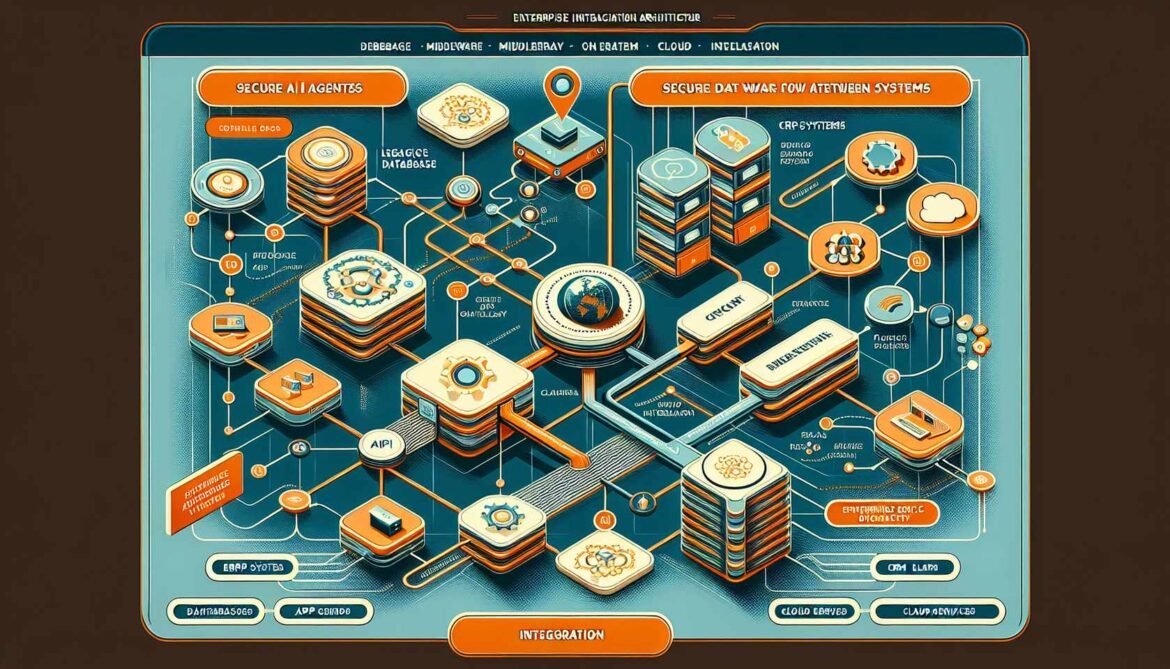
Enterprise AI agents generate value by interacting with existing business systems, not by operating in isolation. Production agents query customer databases, update CRM records, retrieve inventory data, process financial transactions, and orchestrate workflows across multiple applications. These integrations present fundamental challenges: legacy systems lack modern APIs, authentication spans multiple identity providers, data consistency requires transaction management, and network boundaries enforce security policies that complicate agent access. Organizations that solve these integration challenges unlock agent capabilities across their technology landscape while maintaining the security and reliability that enterprise operations demand.
This article examines integration patterns that connect agents with enterprise systems safely and reliably. We explore database integration strategies with connection pooling and query optimization, API integration patterns using REST and GraphQL, authentication mechanisms across system boundaries, transaction management for multi-system workflows, and error handling that maintains data integrity when integrations fail. These patterns enable agents to access enterprise data while preserving the security controls and operational practices that protect business-critical systems.
Database Integration Patterns
Agents frequently need database access to retrieve customer information, product catalogs, transaction history, and operational metrics. Direct database connections from agents create risks including SQL injection vulnerabilities, connection pool exhaustion, and uncontrolled query patterns that degrade database performance. Production patterns implement protective layers between agents and databases through connection pooling that manages database connections efficiently, query validation that prevents malicious queries, result set limits that prevent resource exhaustion, and read replicas that isolate agent queries from production write traffic.
The implementation demonstrates secure database integration. Organizations establish connection pools, validate queries, implement timeouts, and use read replicas for agent workloads. This pattern protects production databases while giving agents necessary data access.
API Integration and Service Mesh
Modern enterprises expose capabilities through REST APIs, GraphQL endpoints, and gRPC services. Agents consume these APIs to retrieve data and trigger business logic. Direct API calls from agents create operational challenges including authentication token management, rate limit handling, circuit breaking when services fail, and request tracing across distributed systems. Service mesh technologies like Istio provide infrastructure-level solutions managing mutual TLS between services, implementing automatic retries with exponential backoff, enforcing circuit breakers to prevent cascade failures, and providing distributed tracing for debugging.
Organizations deploy API gateways as the entry point for agent API access. The gateway handles authentication, rate limiting, request transformation, and response caching. This centralized control point enables consistent security policies and operational monitoring across all agent API interactions.
Authentication and Authorization Across Boundaries
Enterprise systems use diverse authentication mechanisms including Active Directory, SAML federation, OAuth 2.0, API keys, and client certificates. Agents must authenticate to multiple systems using appropriate credentials for each. Credential management challenges include secure storage of multiple credentials, token refresh before expiration, credential rotation without service interruption, and audit logging of credential usage. Organizations implement credential vaulting through systems like Azure Key Vault, AWS Secrets Manager, or HashiCorp Vault that provide encrypted storage, automatic rotation, access auditing, and just-in-time credential provisioning.
The pattern implements workload identity where agents authenticate using managed identities rather than stored credentials. Azure Managed Identity, AWS IAM Roles, and Google Cloud Service Accounts provide credentials automatically without storing secrets in code or configuration.
Transaction Management and Data Consistency
Agents orchestrating multi-system workflows face distributed transaction challenges. An order processing agent might update inventory, charge payment, and notify shipping. If any step fails, the system must maintain consistency. Traditional ACID transactions do not span multiple services. Organizations implement saga patterns where each step is a local transaction with compensating actions that undo changes if later steps fail. Event sourcing captures all state changes as events, enabling replay and audit. Idempotent operations ensure repeated executions produce the same result, handling network retries safely.
Conclusion
Integrating agents with enterprise systems requires architectural patterns that balance capability with control. The strategies examined provide proven approaches for database access, API consumption, authentication management, and transaction handling. Organizations implementing these patterns enable agents to access enterprise data and orchestrate business processes while maintaining the security, reliability, and consistency that production systems demand. The next article examines security considerations specific to agentic AI including prompt injection prevention, data exfiltration controls, and secure agent deployment patterns.