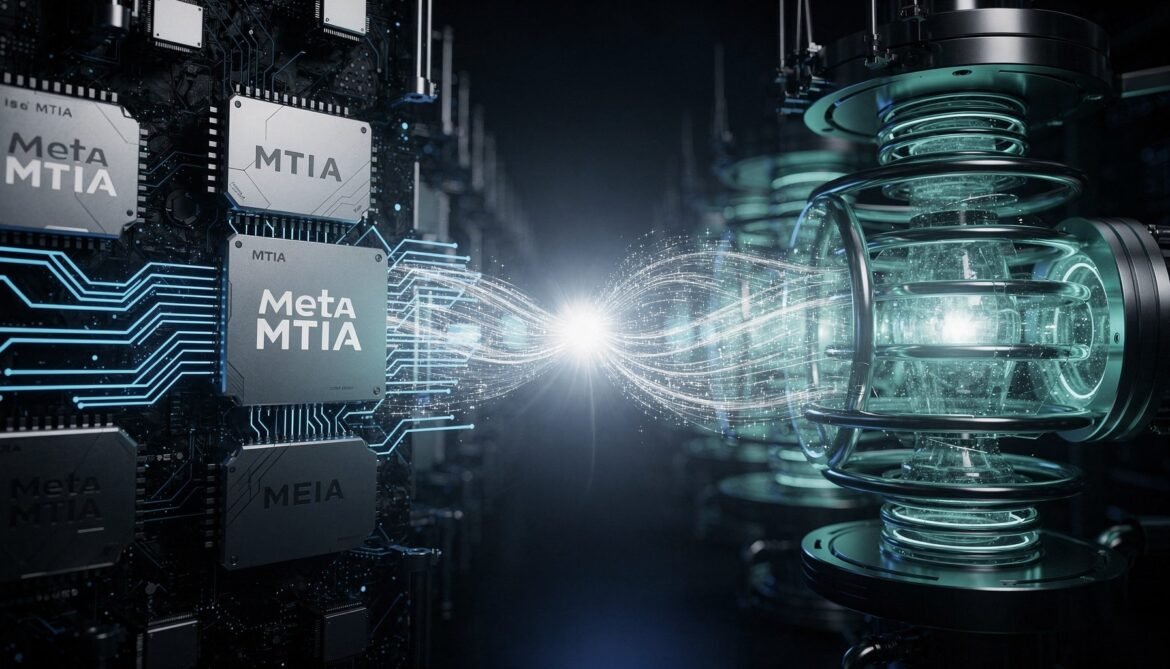
April 2026 is turning into a landmark month for hardware. Two major storylines are converging: hyperscalers doubling down on custom silicon to break free from GPU dependency, and quantum computing labs securing the capital and technical milestones needed to move from laboratory curiosity to industrial reality. Here is a look at what is happening right now and what it means for the next two years.
Meta Goes All-In on Custom Silicon
On March 11, Meta publicly detailed the most aggressive custom chip roadmap any hyperscaler has announced: four successive generations of its Meta Training and Inference Accelerator (MTIA) chips, all slated for deployment within two years. Rather than the industry-standard one to two year cycle between chip generations, Meta is targeting a release cadence of every six months or less.
The lineup breaks down as follows. The MTIA 300 is already in production, handling ranking and recommendations training. The MTIA 400 has completed its testing phase and is moving into Meta data centers imminently to take on generative AI inference. The MTIA 450 follows in early 2027, doubling the HBM bandwidth of the 400. The MTIA 500 arrives later in 2027, capping off a progression that represents a 4.5x increase in HBM bandwidth and a 25x increase in compute FLOPs across the full MTIA 300-to-500 span.
The strategic calculus is straightforward. Meta currently runs billions of AI-driven interactions daily and its reliance on third-party accelerators is both a cost and a supply chain risk. By owning the silicon from the ground up and refreshing every six months, Meta gains a feedback loop between its AI workloads and its hardware design teams that no external vendor can replicate. The architecture is deliberately modular and reusable across generations, which is what makes the aggressive cadence feasible.
Meta MTIA Custom Silicon Roadmap
flowchart LR
    A["MTIA 300
In Production
Training workloads"] --> B["MTIA 400
Testing Complete
GenAI Inference"]
    B --> C["MTIA 450
Early 2027
2x HBM bandwidth"]
    C --> D["MTIA 500
Late 2027
4.5x HBM | 25x FLOPs"]
    style A fill:#4CAF50,color:#fff,stroke:#388E3C
    style B fill:#2196F3,color:#fff,stroke:#1565C0
    style C fill:#9C27B0,color:#fff,stroke:#6A1B9A
    style D fill:#FF5722,color:#fff,stroke:#BF360C
The diagram above illustrates the four-generation progression Meta has committed to. Each chip builds on the modular foundation of its predecessor, allowing the team to iterate on performance-critical components such as HBM bandwidth and compute density without redesigning the entire system from scratch.
Quantum Computing Raises Serious Money
While Meta moves fast on classical silicon, the quantum computing sector is entering a new phase of industrial credibility. Two funding rounds in the first week of April tell the story.
SpinQ Technology closed a Series C+ round at the start of April, bringing its total Series C funding to nearly 1 billion Chinese yuan, approximately $145.3 million USD. The capital is earmarked for high-qubit superconducting chip research and the expansion of standardized, large-scale production lines. SpinQ’s latest QPU C Series chips operate at around 20 millikelvin, support up to 103 superconducting qubits in a high-density 2D lattice topology, and natively support quantum error correction with surface-code up to code distance d=7. The company reported an 80% year-over-year increase in order volume in Q1 2026, with superconducting business now accounting for 65% of total revenue.
On April 2, CavilinQ closed an $8.8 million seed round. Founded by researchers from Harvard and the University of Chicago, the company is developing modular quantum interconnects specifically for fault-tolerant neutral-atom systems. The target is high-speed networking between quantum processing units, addressing one of the hardest bottlenecks in scaling quantum computers beyond a single chip. This kind of interconnect infrastructure is to quantum computing what PCIe and NVLink are to classical GPU clusters: the plumbing that turns individual compute nodes into a unified system.
Quantum Hardware Funding Comparison – Q1 2026
flowchart TD
    A[Quantum Computing Investment Q1 2026] --> B[SpinQ Technology]
    A --> C[CavilinQ]
    A --> D[PsiQuantum - Sep 2025]
    B --> B1["$145.3M USD Series C
High-qubit superconducting chips
103 qubits, surface-code d=7
80% YoY order growth"]
    C --> C1["$8.8M Seed Round
Modular quantum interconnects
Neutral-atom fault-tolerant systems
Harvard + U Chicago founders"]
    D --> D1["$1B USD Funding
Photonic quantum processors
Silicon photonics platform"]
    style A fill:#1A237E,color:#fff
    style B fill:#283593,color:#fff
    style C fill:#283593,color:#fff
    style D fill:#283593,color:#fff
    style B1 fill:#E3F2FD,color:#000
    style C1 fill:#E3F2FD,color:#000
    style D1 fill:#E3F2FD,color:#000
Google TurboQuant: Six Times Less Memory at Inference
On the classical AI side, Google’s research team presented TurboQuant at ICLR 2026. The algorithm targets a persistent problem in large language model deployment: the memory cost of the KV cache during inference. TurboQuant enables quantization of the KV cache down to just 3 bits with no measurable accuracy loss, reducing memory usage by at least six times compared to standard approaches.
For operators running large-scale inference infrastructure, this is a material reduction in hardware cost per query. A six-fold reduction in KV cache memory translates directly into either more concurrent users per GPU or the ability to run longer context windows on the same hardware. Neither benefit is trivial when operating at billions of queries per day.
Venture Capital Sets a New Quarterly Record
The investment data for Q1 2026 is striking. Global venture deal value hit $267.2 billion, more than double the previous quarterly record. The capital is flowing toward AI infrastructure, custom silicon, and quantum hardware at a rate that suggests the industry is in an infrastructure build-out cycle comparable to the early years of cloud computing. Samsung, Oracle, and TikTok’s parent company have all made headline-level commitments to data center and chip investment in April alone.
This is not speculative capital chasing paper returns. These are real capacity commitments: fabrication lines, data center footprint, and engineering headcount. The infrastructure being built in 2026 will determine which organizations have access to compute at scale in 2028 and beyond.
What This Means Going Forward
Three themes connect these stories. First, the era of buying commodity accelerators off the shelf is ending for the largest tech companies. Custom silicon is becoming a competitive moat, and the six-month chip cadence Meta is targeting will pressure the rest of the industry to accelerate. Second, quantum computing has passed the point where it is purely a research bet. Companies are now building production lines and interconnect infrastructure, which is what industrial scaling looks like in its early stages. Third, the capital flowing into hardware at both the classical and quantum level is creating a compounding dynamic: more investment funds better chips, better chips lower the cost of AI, lower cost drives more deployment, more deployment generates revenue to fund the next chip generation.
April 2026 is not a turning point in the sense of a single dramatic announcement. It is a turning point in the sense that several long-running trends are now moving fast enough to matter in a business planning horizon of one to two years. Organizations that treat hardware strategy as an infrastructure commodity are going to find themselves at a growing disadvantage against those that treat it as a core competency.
References
- Meta AI Blog – “Four MTIA Chips in Two Years: Scaling AI Experiences for Billions” (https://ai.meta.com/blog/meta-mtia-scale-ai-chips-for-billions/)
- Meta Newsroom – “Expanding Meta’s Custom Silicon to Power Our AI Workloads” (https://about.fb.com/news/2026/03/expanding-metas-custom-silicon-to-power-our-ai-workloads/)
- CNBC – “Meta rolls out in-house AI chips weeks after massive Nvidia, AMD deals” (https://www.cnbc.com/2026/03/11/meta-ai-mtia-chip-data-center.html)
- The Quantum Insider – “SpinQ Technology Secures Nearly 1 Billion Chinese Yuan in Series C Funding to Scale Industrial Superconducting Quantum Computing” (https://thequantuminsider.com/2026/04/03/spinq-technology-secures-nearly-1-billion-chinese-yuan-in-series-c-funding-to-scale-industrial-superconducting-quantum-computing/)
- Quantum Computing Report – “SpinQ Technology Raises Nearly 1 Billion CNY ($145.3M USD) to Scale Industrial Quantum Computing” (https://quantumcomputingreport.com/spinq-technology-raises-nearly-1-billion-cny-145-3m-usd-to-scale-industrial-quantum-computing/)
- Tech Startups – “Top Tech News Today, April 8, 2026” (https://techstartups.com/2026/04/08/top-tech-news-today-april-8-2026/)
- USDSI – “Latest Developments in Quantum Computing – 2026 Edition” (https://www.usdsi.org/data-science-insights/latest-developments-in-quantum-computing-2026-edition)