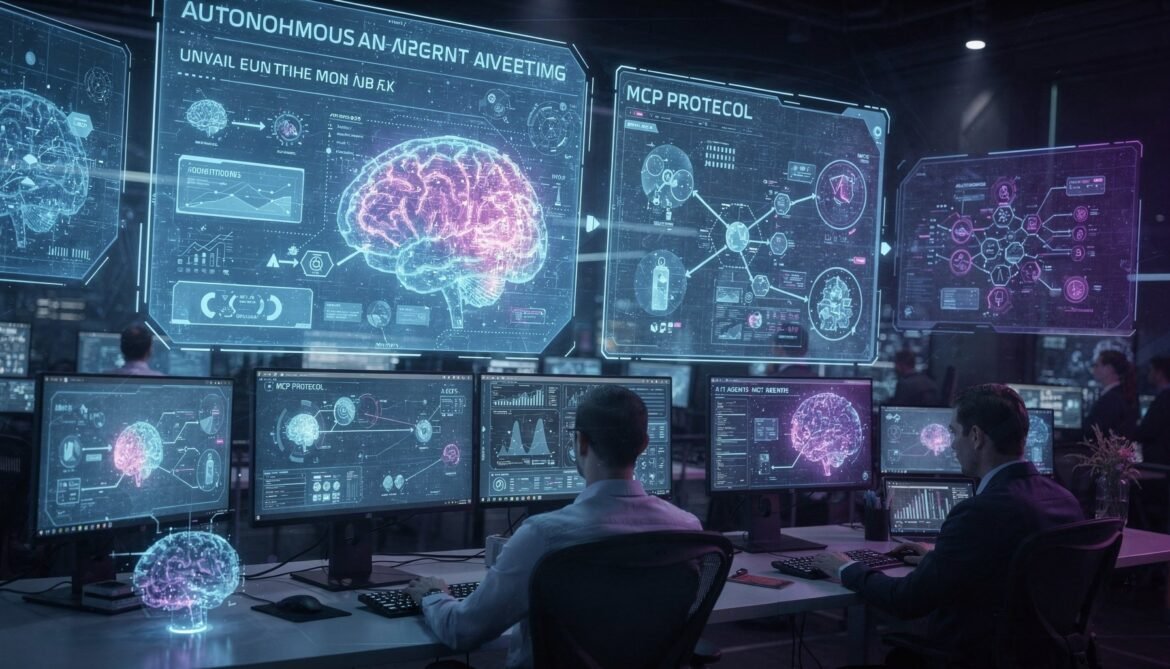
April 2026 marks a decisive moment in enterprise technology. The conversation has moved beyond large language models generating text on demand. The dominant story now is agentic AI: systems that plan, reason, use tools, and execute multi-step workflows with minimal human intervention. Gartner projects that 40 percent of enterprise applications will embed AI agents by the end of 2026, up from less than 5 percent just twelve months ago. That is not a gradual trend. That is a structural transformation of how software gets built and deployed.
This post covers the most significant AI developments from the first week of April 2026: the model releases that matter, the protocol that quietly became foundational infrastructure, the operating system integrations changing how users interact with devices, and the security gap that enterprises are racing to close.
From Chatbots to Autonomous Workflows: The Agentic Shift
The term “agentic AI” has been overused, but the underlying reality is concrete. An AI agent is a system that can perceive its environment, form goals, plan sequences of actions, invoke external tools, and iterate until a task is complete. In 2025, most agent deployments were proofs of concept. In 2026, they are running payroll reconciliations, drafting and filing regulatory reports, managing cloud infrastructure, and routing customer escalations without a human in the loop for routine cases.
Snowflake and OpenAI announced a $200 million strategic partnership specifically aimed at accelerating agentic AI deployment for corporate enterprises. Amazon launched a Health AI agent giving Prime members free 24/7 access to personalized health guidance. The agent answers health questions, interprets lab results, manages prescription renewals, and books appointments. These are not demos. They are production services at scale.
The democratization angle is equally significant. No-code and low-code agent builders have matured to the point where a business analyst with no programming background can configure a multi-step autonomous agent in an afternoon. The design and deployment of intelligent agents is moving beyond engineering teams into the hands of everyday business users.
MCP: 97 Million Installs and the New Foundational Layer
Anthropic introduced the Model Context Protocol in late 2024 as a standard for connecting AI systems to external tools and data sources. By March 2026, MCP crossed 97 million installs, and every major AI provider now ships MCP-compatible tooling. OpenAI, Google, Hugging Face, and LangChain have all standardized around it. The protocol has completed its transition from experimental standard to foundational agentic infrastructure in under eighteen months.
The Agentic AI Foundation, formed under the Linux Foundation in December 2025, is anchored by contributions from Anthropic’s MCP, OpenAI’s AGENTS.md specification, and Block’s goose framework. The 2026 MCP roadmap focuses on production readiness: better authentication and authorization primitives, tooling for discovering and securing MCP servers, agentic monetization patterns, and the first production-ready MCP applications that render results as interactive dashboards rather than plain text.
The diagram below illustrates the architecture of a modern agentic AI stack built on MCP:
flowchart TD
    A[Enterprise Application] --> B[AI Agent Core]
    B --> C[Planning and Reasoning]
    B --> D[Memory and Context]
    B --> E[MCP Protocol Layer]
    E --> F[REST APIs]
    E --> G[Databases]
    E --> H[Code Execution Sandbox]
    E --> I[File Systems]
    C --> B
    D --> B
The Frontier Model Landscape: April 2026 Snapshot
The model race has not slowed. Here is where the major providers stand as of early April 2026:
- OpenAI GPT-5.4: Released March 5, 2026. The Thinking variant integrates test-time compute and has surpassed human-level performance on desktop task benchmarks, scoring 75.0% on OSWorld-Verified and a record 83% on the GDPval knowledge work benchmark.
- Google Gemini 3.1 Pro: Tops reasoning benchmarks with 94.3% on GPQA Diamond. Gemma 4, Google’s open-weights model, was released April 2, 2026, specifically positioned to compete with Chinese open-source alternatives.
- Anthropic Claude Sonnet 4.6 and Opus 4.6: Released February 2026. Claude Sonnet 4.6 performs at near-Opus level at Sonnet pricing and leads the GDPval-AA Elo benchmark with 1,633 points, making it the current benchmark leader for knowledge work tasks in enterprise settings.
- Alibaba Qwen3.6-Plus: A major advancement in agentic coding and multimodal reasoning. The model handles cross-modal tasks including high-density document parsing, physical-world visual analysis, and long-form video reasoning up to two hours in length.
- xAI Grok 4.20 Beta 2: Released March 3, 2026. xAI and Meta are currently trailing the top three US labs. DeepSeek and Alibaba’s Qwen have grown from 1% to 15% of the global AI market in twelve months, reshaping the competitive landscape.
AI Enters the Operating System
The integration of AI agents into operating systems represents the next layer of the agentic shift. Google has integrated Gemini as a core autonomous task engine across Android and upcoming flagship devices including the Galaxy S26 and Pixel 10, enabling complex flows such as travel booking without manual prompts. Apple has teased significant upgrades to Siri for WWDC 2026, focusing on on-device agentic workflows that leverage the Secure Enclave for privacy-preserving execution.
On the physical side, Nvidia officially confirmed NemoClaw in early March 2026: an open-source AI agent platform for robotics and physical AI. The convergence of software agents and physical actuators is what analysts are calling embodied AI, where autonomous systems interact with the physical world rather than only digital interfaces. This positions robotics companies, logistics operators, and manufacturing firms as the next major adopters of agentic AI infrastructure.
The Governance Gap: Deploying Faster Than Securing
The acceleration of agent deployment has outpaced enterprise security practices by a significant margin. Most Chief Information Security Officers report deep concern about AI agent risks, yet only a handful of organizations have implemented mature safeguards. The attack surface introduced by AI agents is qualitatively different from traditional software: an agent with tool access to databases, APIs, file systems, and code execution environments is a high-value target for prompt injection, privilege escalation, and data exfiltration.
The 2026 MCP roadmap addresses some of these concerns by defining authentication and authorization standards for tool servers, but the burden of implementing those standards falls on engineering teams already stretched thin deploying agents at scale. Organizations that establish agent governance frameworks now, covering audit trails, scope limitation, human-in-the-loop escalation paths, and credential isolation, will have a measurable advantage over those that treat governance as a post-deployment concern.
What This Means for Engineers and Developers
For engineers building on these platforms, April 2026 brings both opportunity and increased responsibility. The MCP ecosystem now offers a mature toolkit for connecting agents to virtually any data source or API. The frontier models available via API handle complex reasoning tasks that required expensive fine-tuning or custom model development twelve months ago. The no-code agent builders are absorbing simpler automation use cases, which means engineering teams should focus on the higher-complexity problems: multi-agent coordination, long-horizon task execution, reliable tool-use under adversarial conditions, and governance infrastructure.
Node.js, Python, and Rust all have mature MCP client libraries. The agent SDK ecosystem has stabilized around a small number of well-maintained frameworks. The ramp-up time to build production-grade agentic applications in April 2026 is measured in days, not months. The barrier is no longer technical access. It is organizational readiness to govern and operate autonomous systems responsibly.
References
- IBM Think – “The Trends That Will Shape AI and Tech in 2026” (https://www.ibm.com/think/news/ai-tech-trends-predictions-2026)
- Machine Learning Mastery – “7 Agentic AI Trends to Watch in 2026” (https://machinelearningmastery.com/7-agentic-ai-trends-to-watch-in-2026/)
- Alibaba Cloud – “Alibaba Unveils Qwen3.6-Plus to Accelerate Agentic AI Deployment for Enterprises” (https://www.alibabacloud.com/blog/alibaba-unveils-qwen3-6-plus…)
- CData – “2026: The Year for Enterprise-Ready MCP Adoption” (https://www.cdata.com/blog/2026-year-enterprise-ready-mcp-adoption)
- The New Stack – “MCP’s Biggest Growing Pains for Production Use Will Soon Be Solved” (https://thenewstack.io/model-context-protocol-roadmap-2026/)
- Google Blog – “5 Ways AI Agents Will Transform the Way We Work in 2026” (https://blog.google/innovation-and-ai/infrastructure-and-cloud/google-cloud/ai-business-trends-report-2026/)
- Acuvate – “2026 Agentic AI Trends: Expert Insights on Autonomous Systems” (https://acuvate.com/blog/2026-agentic-ai-expert-predictions/)
- Medium / Marc Bara – “Q1 2026: The Frontier AI Field Is Splitting” (https://medium.com/@marc.bara.iniesta/q1-2026-the-frontier-ai-field-is-splitting-b5b7f6a49ba9)
- The Register – “Google Battles Chinese Open Weights Models with Gemma 4” (https://www.theregister.com/2026/04/02/googles_gemma_4_open_weights/)
- LLM Stats – “AI Updates Today (April 2026): Latest AI Model Releases” (https://llm-stats.com/llm-updates)